Percent of Americans Who Read a Book
Story Highlights
- Average number of books read downwards to 12.6 from 15.6 in 2016
- Percent reading whatsoever books is stable; fewer are reading more than 10
- Higher graduates show largest reject in number of books read
WASHINGTON, D.C. -- Americans say they read an boilerplate of 12.six books during the past yr, a smaller number than Gallup has measured in whatsoever prior survey dating back to 1990. U.S. adults are reading roughly two or three fewer books per twelvemonth than they did betwixt 2001 and 2016.
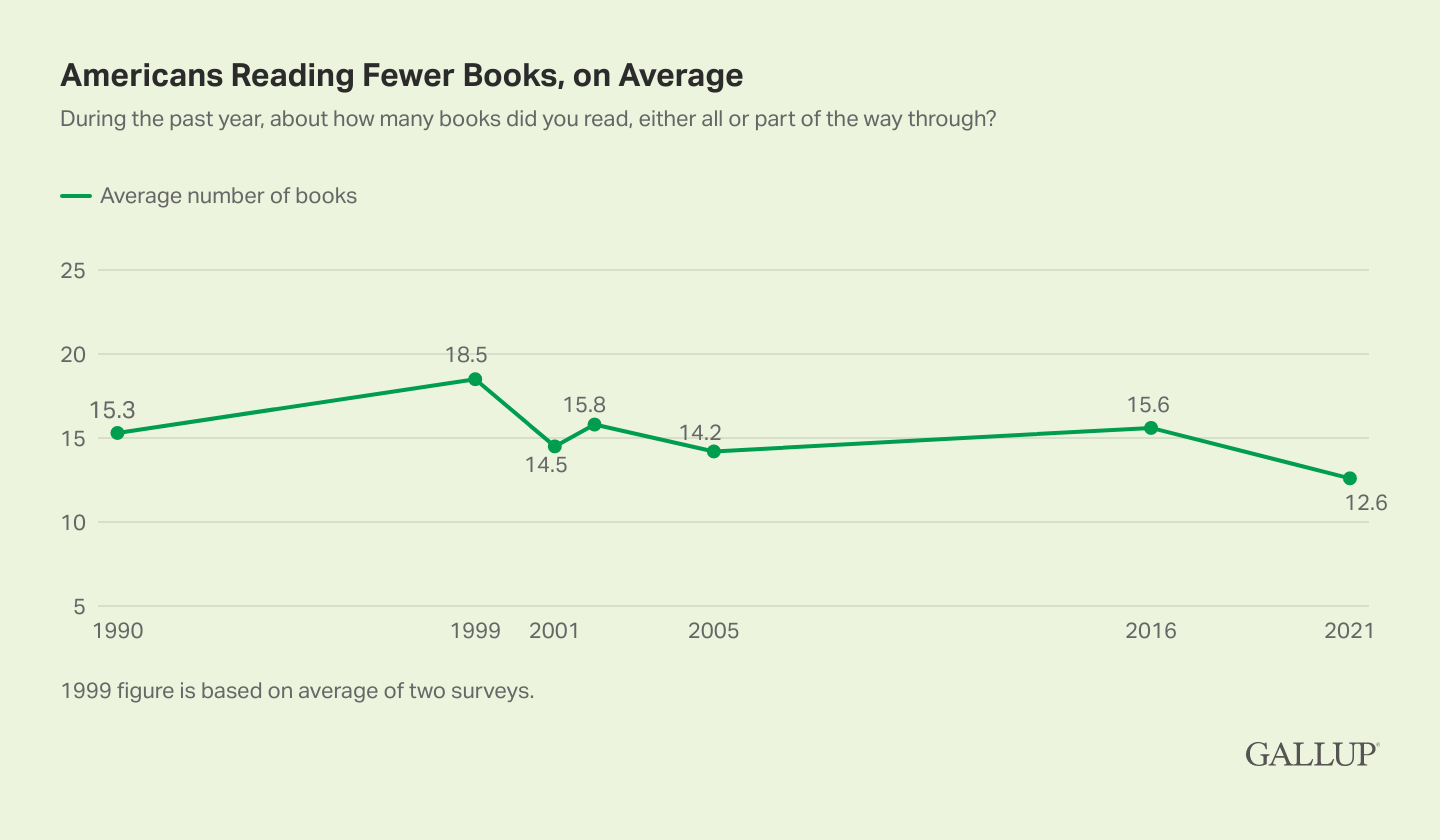
Line graph. Trend in average number of books Americans say they read in the past year. The 12.6 average for 2021 is down from xv.half dozen in 2016 and lower than whatsoever other year Gallup asked the question, including xiv.ii in 2005, 15.8 in 2002, xiv.5 in 2001, 18.5 in 1999 and 15.3 in 1990.
The results are based on a Dec. 1-16 Gallup poll, which updated a trend question on volume reading. The question asks Americans to say how many books they "read, either all or part of the style through" in the past year. Interviewers are instructed to include all forms of books, including printed books just also electronic books and audiobooks, when entering the respondent's answer.
The turn down in book reading is more often than not a function of how many books readers are reading, as opposed to fewer Americans reading any books. The 17% of U.Southward. adults who say they did not read whatsoever books in the past year is similar to the 16% to 18% measured in 2002 to 2016 surveys, though it is higher than in the 1999 to 2001 polls.
The drop is fueled by a refuse in the percentage of Americans reading more than x books in the past yr. Currently, 27% report that they read more than 10 books, down eight percent points since 2016 and lower than every prior measure by at least four points.
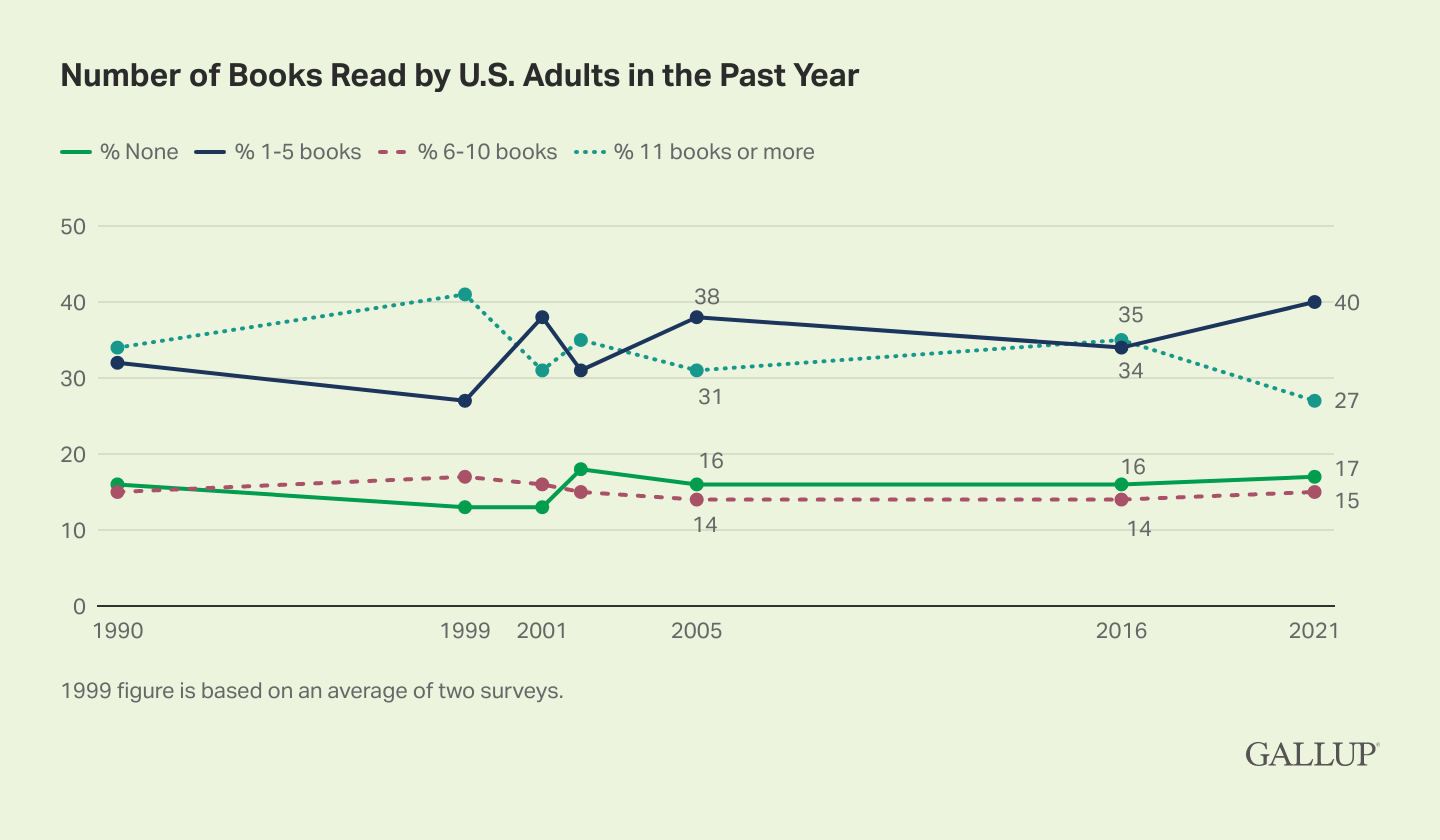
Line graph. Trend in number of books Americans say they read in the past yr. In 2021, 17% of U.Southward. adults said they read no books in the past year, about the aforementioned pct as in the prior reading in 2016 and similar to well-nigh readings since 1990. At the same time, there was a decline in the number reading more than 10 books, from 35% in 2016 to 27% in 2021. That subtract was offset by an increase in the percent reading 1 to 5 books, from 34% to 40%. The percentage reading vi to x books was steady at 15%.
The reasons for the decline in book reading are unclear, with Americans perhaps finding other ways to entertain themselves. It is uncertain whether concerns about COVID or COVID-related restrictions are leading to a decline in visits to libraries or bookstores, similar to the documented declines in air travel and film theater attendance Gallup found in the same poll. Still, unlike those activities, for reading, Americans tin order books or download electronic books or audiobooks without leaving their homes.
Higher Graduates Evidence Steep Decline in Book Readership
Americans in most major subgroups are reading fewer books at present than in the by. This is based on a comparison of the 2021 results to an average of those from the three polls conducted between 2002 and 2016. During those years, Americans read an average of 15.2 books a twelvemonth.
The decline is greater among subgroups that tended to exist more avid readers, particularly higher graduates merely as well women and older Americans. College graduates read an boilerplate of about 6 fewer books in 2021 than they did between 2002 and 2016, 14.six versus 21.i.
In the by, women read close to twice as many books as men did, but the gap has narrowed equally the average U.Southward. woman read 15.7 books last twelvemonth, compared with xix.3 between 2002 and 2016. Over the same period, men'southward readership declined by barely 1 book, to 9.five.
Older adults traditionally read a lot more than than younger adults did, simply that difference has vanished, with Americans aged 55 and older dropping from an average of 16.vii books read a year to 12, while there has been little change in the average number read by those younger than 55.
Alter in Average Number of Books Read, past Subgroup, 2002-2016 versus 2021
| 2002-2016 | 2021 | Change | |
|---|---|---|---|
| U.S. adults | 15.2 | 12.6 | -2.6 |
| Gender | |||
| Men | 10.8 | ix.5 | -1.3 |
| Women | 19.three | fifteen.seven | -3.six |
| Age | |||
| 18-34 years | 13.8 | 13.0 | -0.8 |
| 35-54 years | fourteen.two | 12.five | -1.7 |
| 55+ years | xvi.7 | 12.0 | -four.7 |
| College graduate | |||
| Yes | 21.one | xiv.6 | -half-dozen.5 |
| No | 12.6 | 11.5 | -1.1 |
| Gallup | |||
Once more, reduced book reading amidst these groups is more than a role of fewer people reading larger numbers of books than fewer in the subgroup reading at all. Between 2002 and 2016, close to half of college graduates (48%) read more than 10 books in a year. Last twelvemonth, 35% of college graduates read more than 10 books.
Similarly, the percentage of older adults reading more than than 10 books fell from 34% to 24%, while the percent of women reading that many books dropped from 41% to 32%.
Bottom Line
Reading appears to be in refuse every bit a favorite fashion for Americans to spend their gratuitous time. In 2020, a few months into the COVID-xix pandemic, when many Americans were nevertheless reluctant to leave their homes, Gallup constitute 6% of U.Due south. adults naming reading as their favorite way to spend an evening, downwardly from 12% in 2016. Since Gallup start asked the question in 1960, at least 10% of Americans had identified reading as their favorite evening action in all but 1 survey.
The new data on book reading reinforce that the popularity of reading is waning, with Americans reading an average of three fewer books terminal year than they did 5 years ago and had typically read for the past three decades. The decline is not considering fewer Americans are reading at all -- a pct that has held steady at 17% -- but considering Americans who practise read are reading fewer books. The changes are especially pronounced among the almost voracious volume readers, namely, college graduates, women and older Americans.
Information technology is unclear from these data if the declines in book readership are occurring considering of a lack of interest in books, a lack of time to read books, or peradventure COVID-xix-related disruptions in lifestyle activities or access to books. It is also uncertain at this bespeak whether the declines in book reading marking a temporary modify or a more than permanent ane.
To stay up to date with the latest Gallup News insights and updates, follow u.s.a. on Twitter .
Learn more about how the Gallup Poll Social Series works.
View complete question responses and trends (PDF download).
lauritzenabte1941.blogspot.com
Source: https://news.gallup.com/poll/388541/americans-reading-fewer-books-past.aspx
0 Response to "Percent of Americans Who Read a Book"
Post a Comment